
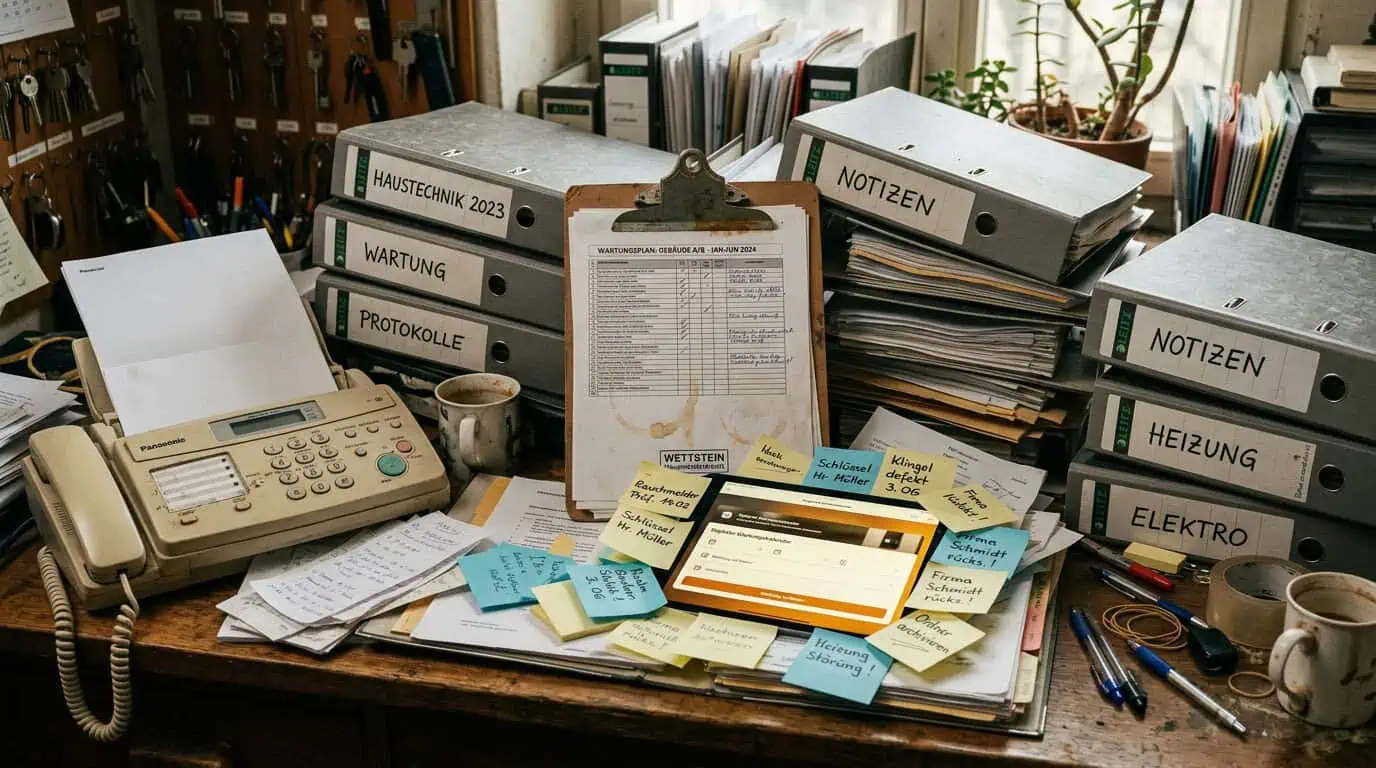
It's time to face a bitter but extremely comforting truth for all of us. Computer-Aided Facility Management, or CAFM, is a passing trend. It will never truly establish itself in the robust, tradition-conscious German real estate landscape. For years, legions of consultants have preached the gospel of digital transformation and hallucinated about seamless data rooms. But they all underestimate our absolute world championship in preserving the status quo through creative excuses.
Why should we revolutionize a system that has proven itself so well?
Since the late eighties, building operations have been maintained by an unshakeable combination of paperwork, verbal instructions, and sheer will to survive. To understand why digitalization stands no chance in our industry, one only needs to visualize an everyday scene.
Slim Fit Meets Building Services
Let's imagine a typical pitch: conference room, glaring fluorescent lights, a thermos of lukewarm filter coffee. At the front stands a dynamic, mid-twenties key account manager in a slim-fit suit. He probably sold cryptocurrencies yesterday and is now determined to revolutionize the real estate industry. He elegantly swipes on his iPad, projecting the high-resolution digital twin of an office building onto the wall.
Look, he gushes with shining eyes, our IoT sensor reports a minimal pressure drop in the heating circuit. Our artificial intelligence analyzes the problem in milliseconds and automatically generates a ticket. Then, the system orders the exact matching spare part from the wholesaler via an API interface. Finally, the technician is navigated centimeter-accurately to the defective valve using augmented reality glasses.
On the other side of the table sits the FM committee. These are seasoned technical managers whose cumulative professional experience exceeds the lifespan of a Galapagos tortoise. An icy silence prevails.
Finally, Mr. Krause, who has been in charge of building services for thirty-three years, slowly leans forward. With the sonorous calm of a man who has survived three corporate mergers, he slides his reading glasses down.
That's all very nice, young man, he says ponderously. But what exactly does your artificial intelligence do when the aforementioned basement door has been sticking since 1996? What happens if the only key to it is on our caretaker's keyring, who is currently on a spa retreat in Norderney? Does your smart glasses also have a button for asbestos-containing fire doors that officially don't even exist?
The salesperson freezes, the iPad sinks onto the tabletop, and the Californian pitch deck shatters spectacularly against the relentless reality of the German building stock.
The Fairy Tale of Standard Software
The first and most effective line of defense after such a meeting is the unwavering belief in our own uniqueness. Every German facility management team is deeply convinced that its processes are so highly specific that no standard software could map them. How we report a defective fluorescent tube in our company is not a trivial matter. It is applied rocket science, intricately interwoven with local folklore and Feng Shui.
When a software manufacturer offers us so-called best practices, we rightly take it as an insult. We won't adapt to the software!
Instead, we demand a customization that is so profound and destructive that it destroys the security of updates. The system must digitally reproduce our analog errors of the last twenty years exactly. After all, anything else would be an unacceptable interference with our operational DNA.
Salvation Through Missing Wi-Fi
Should the argument of uniqueness unexpectedly fail, we draw our strongest structural weapon: reinforced concrete. Modern CAFM solutions rely on mobile apps, real-time ticketing, and QR codes on equipment. Here, we can throw our hands up in despair and lament the poor Wi-Fi reception in the basement with tragic voices.
This argument is an absolute killer and a rhetorical atomic bomb. As long as the ventilation technician in the furthest heating cellar doesn't have at least 5G reception, an FM app is logically completely useless.
We deliberately ignore the fact that modern software has long possessed excellent offline capabilities. The radio-silent basement remains our safest refuge from the relentless transparency of digitalization.
The SAP Illusion of Management
If the FM team still finds itself with its back against the wall, management often steps in with the ultimate excuse. At some point in a crucial board meeting, the argument of the all-encompassing ERP strategywill inevitably be made. The company is now betting everything on SAP across the board, so surely there must be a module for buildings too.
This is the most glorious moment for any digitalization refuser. Everyone in the industry knows: it takes a decade and a half until such a large ERP project is implemented and made usable for facility management. With the pious reference to this overarching IT strategy, the introduction of an agile CAFM solution can be nipped in the bud.
We prefer to wait ten years for a module for financial accountants than to use software for maintenance staff today.
Staff as an Analog Shield
Another rhetorical stroke of genius to prevent innovation is the deep-felt sympathy for our workforce. When we run out of all factual arguments, we point with teary eyes to our 61-year-old building services technician, Heinz. We can't possibly burden the poor man with an iPad shortly before his retirement.
The fact that the aforementioned Heinz already controls his smart home via voice command in his private life is strategically ignored. Heinz is unceremoniously elevated to the defenseless shield of the analog faction. Out of pure concern, we prefer to forgo any efficiency and continue to dutifully print Heinz's work orders on A4 paper. He would miss the smell of the toner anyway.
Should the external pressure become unbearable, there is always the emergency exit of an extensive evaluation phase. In German facility management, we never start pragmatically and agilely. No, first we establish an interdepartmental working group and commission highly paid external consultants. Then we produce a 400-page requirements specification full of obscure special cases that are defined as absolutely system-critical.
The creation of this document takes two years, and the subsequent tender another. When the final cost estimate for the implementation of all special requests is available, we can finally breathe a sigh of relief.
Unfortunately, the budget doesn't allow for it at all, which is why the project has to be postponed until after the roof renovation. The beloved clipboard is safe for another three to five years.
Data Protection as the Ultimate Guardian
Of course, we must not forget to mention our most reliable guardians of the status quo. In no other country is data protection used so creatively as an instrument to prevent progress as it is here. As soon as software is theoretically capable of measuring who has repaired what and for how long, we smell total performance monitoring.
It is far safer for works council culture if sensitive data is transported on unencrypted scribbled notes in an open van. Cloud servers are known to be located somewhere in the evil abroad and are constantly attacked by hackers. The crammed file folder in Mr. Krause's closet, on the other hand, is absolutely secure. At least as long as no one loses the small silver key.
At the end of the day, we always return to the comforting embrace of our historically grown Excel landscape anyway. A file with hundreds of circular references and hidden columns still requires real manual intuition. Modern CAFM software would simply take away the frantic search for that one faulty cell. How terribly boring would that be?
Whoever AI-supported demands Predictive Maintenance is willfully destroying the valuable culture of our fire brigade-style emergency responses. A dedicated FM team must be able to heroically seal a massive pipe burst on a Friday afternoon. Those who excel through preventive maintenance and solve problems before they arise will only be asked what they are actually being paid for.
Therefore, we can all breathe a sigh of relief. As long as we master the art of excuses so skillfully, resistance to CAFM remains unbroken. We preserve our sacred right to inefficient processes, redundant data maintenance, and the incomparable thrill of missing spare parts.
And while we loudly proclaim this, we devoutly listen to the soothing hum of the fax machine in the anteroom.
