
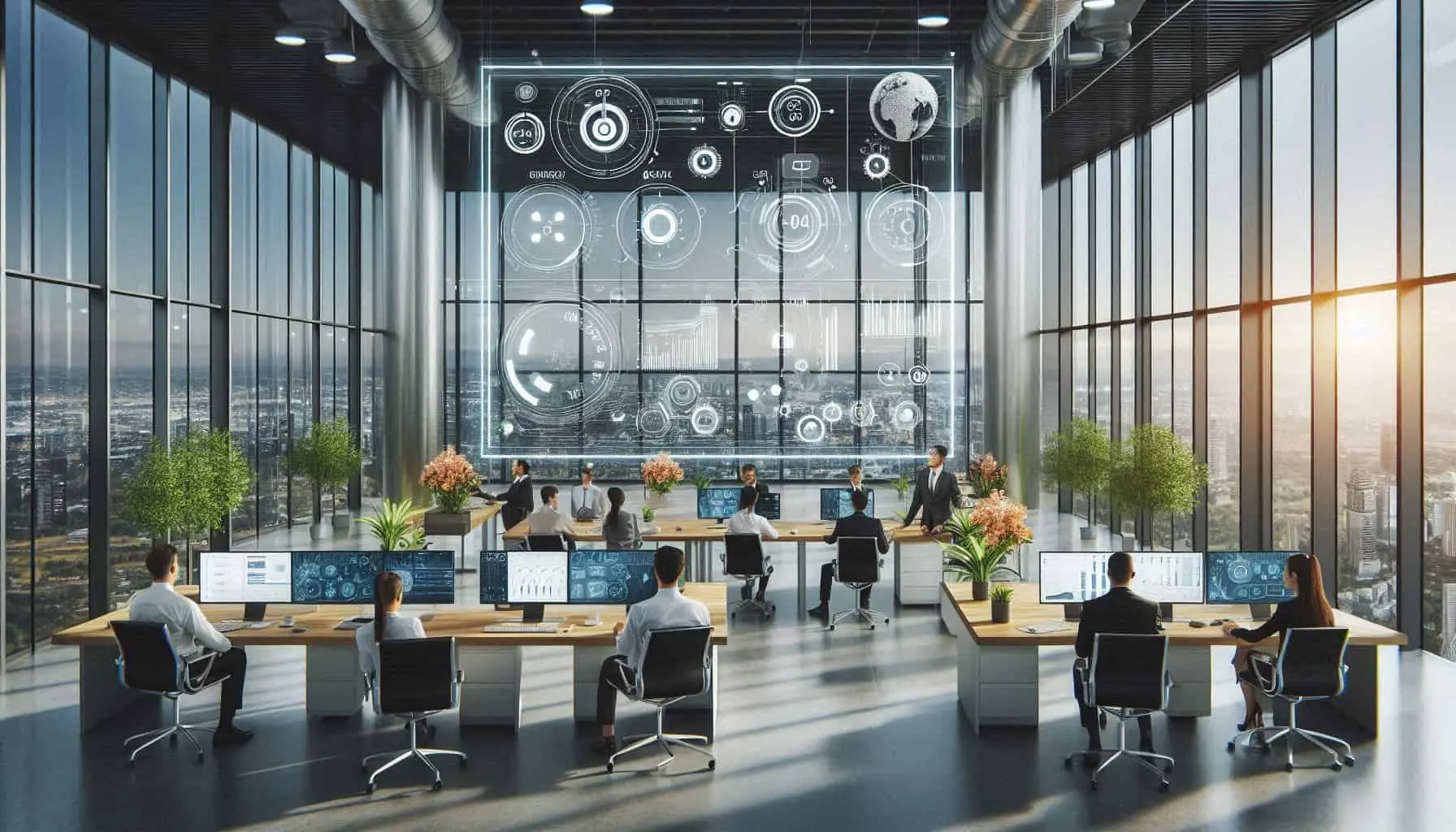
Increasing efficiency in building operations with AI is gaining relevance because buildings today must be operated not only comfortably and safely, but also economically and sustainably. Artificial intelligence (AI) makes it possible to evaluate large amounts of data, recognize patterns, and automatically adjust operational processes. This allows for targeted improvements in energy consumption, maintenance costs, user comfort, and safety.
Basics: How AI is Changing Building Operations
Increasing efficiency in building operations with AI is based on the connection of sensor technology, software, and automated control systems. While conventional buildings are often operated according to fixed schedules, intelligent systems react dynamically to current conditions. They consider, for example, room temperature, humidity, CO2 concentration, weather data, energy prices, and the actual occupancy of a building.
The information required for this comes from IoT sensors, meters, and technical systems. It records, among other things:
- Room temperature and humidity
- CO2 concentration and air quality
- Presence and utilization of rooms
- Energy consumption of individual systems
- Operating status of heating, ventilation, and air conditioning systems
- Vibrations, pressure values, and temperature profiles of technical components
This data forms the basis for informed decisions. The more complete and reliable the data, the more precisely AI can analyze and optimize building operations.
AI-Supported Energy Optimization
There is particularly great potential in energy management. Heating, ventilation, and air conditioning systems are among the largest energy consumers in many buildings. AI systems can adapt their operation to actual demand and avoid unnecessary consumption.
Instead of switching on the heating at fixed times regardless of usage, AI analyzes factors such as occupancy, outside temperature, and weather forecast. If a room is not being used, its heating output can be reduced. If strong solar radiation is expected, the heating output can be adjusted in advance. This creates a dynamic operation that combines comfort and efficiency.
Lighting can also be controlled intelligently. Sensors detect whether people are present in a room and how much daylight is available. The lighting is then automatically dimmed or switched off. This reduces electricity consumption without worsening working conditions.
Load Management and Peak Load Shedding
AI can also help to avoid high load peaks. By analyzing historical consumption data, the system recognizes when particularly high energy is required. Energy-intensive devices can then be operated with a time delay. This not only lowers energy costs but also relieves the electrical infrastructure.
In conjunction with photovoltaic systems, battery storage, and charging stations for electric vehicles, AI can coordinate the energy flow in the building. For example, excess solar power is stored or used for charging vehicles. This increasingly makes the building an active part of a decentralized energy system.
Predictive Maintenance with Machine Learning
Another important area of application is predictive maintenance, also known as predictive maintenance. In reactive maintenance, a system is only repaired after a defect has already occurred. In preventive maintenance, replacement occurs at fixed intervals, regardless of the actual condition.
AI enables a more differentiated approach. It continuously monitors technical systems and detects deviations that may indicate an impending failure. For example, unusual vibrations in pumps, rising temperatures in motors, or changing performance values of ventilation systems can indicate wear and tear.
Maintenance work can thus be planned more precisely. Spare parts can be procured in good time and technicians can be deployed efficiently. At the same time, the risk of unplanned downtimes decreases. The service life of systems can be extended while costs for emergency repairs and operational interruptions are reduced.
Digital Twins as an Intelligent Decision Basis
A digital twin is a virtual representation of a building or a technical system. It is supplied with real-time data from sensors and building management systems and displays the current condition in as much detail as possible.
Different scenarios can be simulated with a digital twin. Operators can, for example, investigate how a new heating strategy, a changed room layout, or the replacement of a system affects energy consumption and comfort. Decisions thus become more predictable and do not have to be based solely on empirical values.
Research initiatives such as the "ai.lab" by Synavision, RWTH Aachen University, and Münster University of Applied Sciences show how AI applications can be practically tested in construction and building operations. Such projects help to assess savings potential and realistically estimate the impact of digital controls.
More Comfort and Safety for Building Users
Efficiency does not mean that user comfort has to be restricted. On the contrary: AI can better take individual needs into account. In office buildings, for example, different climate zones can be created. Lighting can be adapted to the respective activity, while ventilation systems continuously monitor air quality.
Security solutions also benefit from artificial intelligence. Intelligent access systems can detect unusual access times or suspicious patterns. Video analyses can indicate specific situations, such as unauthorized entry, prolonged stays in restricted areas, or unusual movements.
A responsible design is crucial here. The technology used should increase safety without disproportionately restricting users' privacy.
Integration into Existing Facility Management Structures
For AI to bring actual benefits in building operations, it must work together with existing systems. These include building automation technology, CAFM systems, energy management, maintenance planning, and access control.
Open interfaces and standardized protocols are therefore particularly important. Only when systems can exchange data is a comprehensive picture of building operations created. AI-supported applications can then automatically create maintenance orders, process user requests, or forward anomalies to the responsible employees.
Context-sensitive chatbots like FM-Assist also show how artificial intelligence can support operational processes. They can process information from CAFM systems and answer recurring queries more quickly. Human specialists are not replaced, but relieved of routine tasks.
Data Quality and Data Protection as Key Challenges
The performance of an AI system depends directly on the quality of its data. Incorrect, incomplete, or contradictory information leads to inaccurate forecasts and wrong control decisions. Therefore, data must be regularly checked, cleaned, and validated.
Data protection requires special attention. As soon as personal data, movement patterns, or individual usage profiles are processed, the provisions of the General Data Protection Regulation must be observed. Operators should clearly define which data are needed, how long they will be stored, and who will have access to them.
Transparent information, technical security measures, and data-minimizing planning build trust. Not all information that can be theoretically captured is actually necessary for efficient building operations.
Economic and Ecological Benefits
Increasing efficiency in building operations with AI can significantly reduce operating costs. Savings are achieved through lower energy consumption, fewer unplanned repairs, better utilization of technical systems, and more efficient workflows in facility management.
At the same time, AI supports sustainability. Precise control of heating, cooling, ventilation, and lighting reduces CO2 emissions. In combination with renewable energies, a building can further reduce its ecological footprint.
The increasing use of AI in the construction and real estate industry shows that the market is developing towards data-based and automated processes. According to studies, numerous construction companies are already using artificial intelligence in at least one project phase. This development is likely to continue in building operations.
Future Prospects for Smart Buildings
By 2026, AI-based optimization, interoperability, and intelligent energy management will be among the most important topics in smart buildings. Buildings will increasingly be able to independently adapt to changing weather conditions, energy prices, occupancy patterns, and user requirements.
This requires not only powerful technology but also qualified specialists. Engineers, technicians, and facility managers must understand building technology as well as the basics of data analysis and artificial intelligence.
In the long term, the building will evolve from a passive structure to a learning, networked system. It will recognize its own condition, react proactively to changes, and continuously optimize its operation. In this way, AI can help to permanently combine comfort, safety, economic efficiency, and climate protection.
