
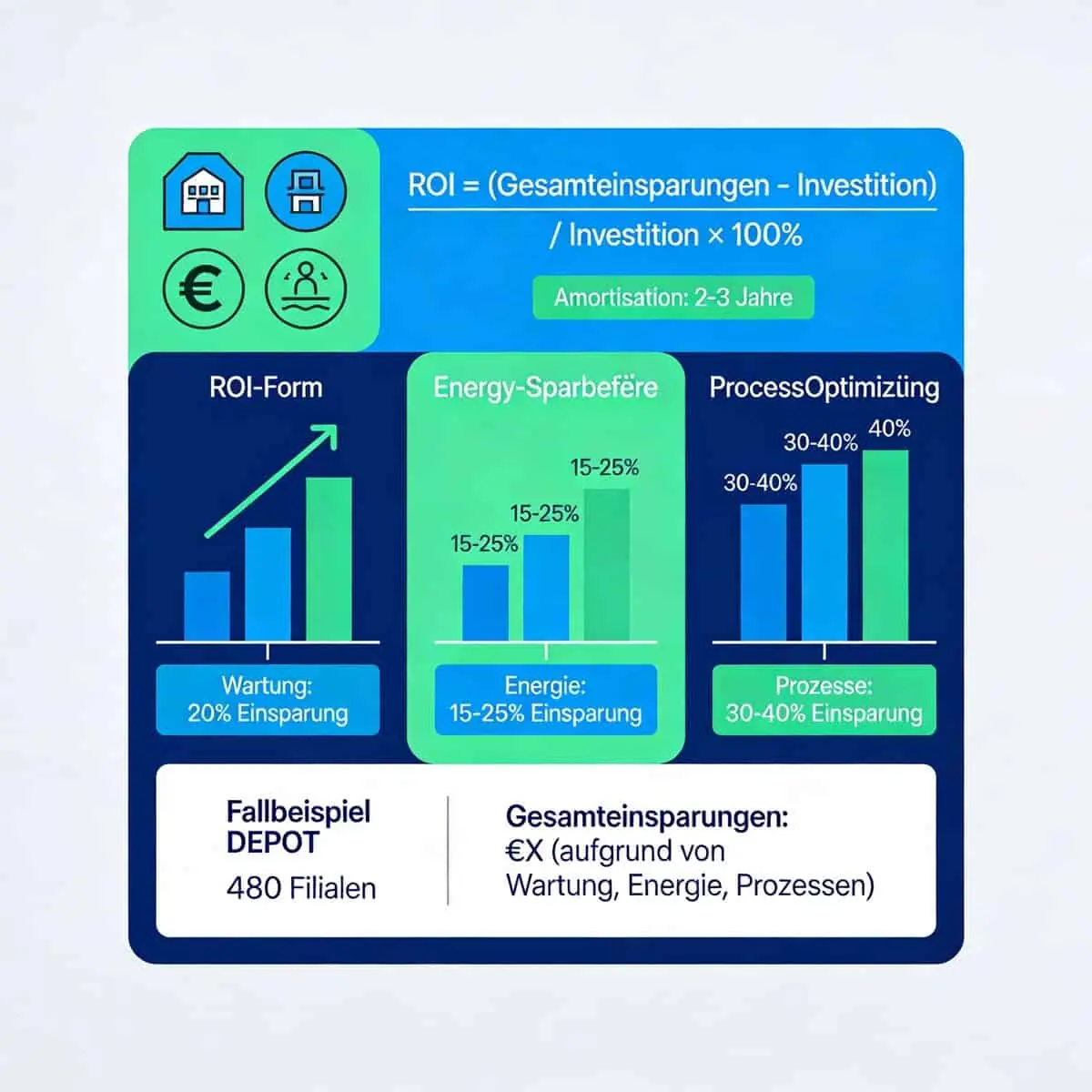
Cost savings through CAFM can be determined in a practical way using ROI calculations, based on efficiency gains and reductions in maintenance, energy, and personnel. Studies typically show 20-60% savings in relevant areas. [Source / Source]
Calculation Methods
GEFMA 460 standardizes economic efficiency analysis: Determine costs (introduction, operation) and benefits (savings in 15 functional areas) using investment calculation with an interest rate factor. [Source]
Steps: 1. Quantify effort (internal/external) (e.g., hourly wage × time). 2. Evaluate benefits (e.g., € savings per process). 3. ROI = (Benefits – Costs) / Costs × 100, payback in 2-3 years. [Source]
Tools like Excel or integrated CAFM modules automate dashboards for KPIs such as cost per m².[Source]
Practical Figures from Studies
-
More than 60% of users save costs through better transparency and efficiency; Trend Study 2013: Documentation and services optimized.
-
20% lower maintenance costs, 15-25% energy savings, 30-40% faster problem resolution.[Source]
-
Energy example: Reducing consumption from 900 to 750 kWh/m² = 16.7% savings through monitoring and measures.[Source]
Automation reduces personnel costs by up to 30%.[Source]
Case Study: DEPOT
For 480 branches: 80% automation of reports reduced processing time and external costs; ROI achieved in months through central control.[Source]
Assumption: €10/hour × 1 hour/report × 80% × 12,000 reports/year = €96,000 savings.
Table: Typical Savings
| Area | Savings per Year | Source |
|---|---|---|
| Maintenance | 20% | [Source] |
| Energy | 15-25% | [Source] |
| Processes | 30-40% | [Source] |
| Total (Study) | >60% Users | [Source] |
Adapt to your portfolio: Multiply area × rate (e.g., 1 million m² × €5/m² savings = €5 million). [Source]
