
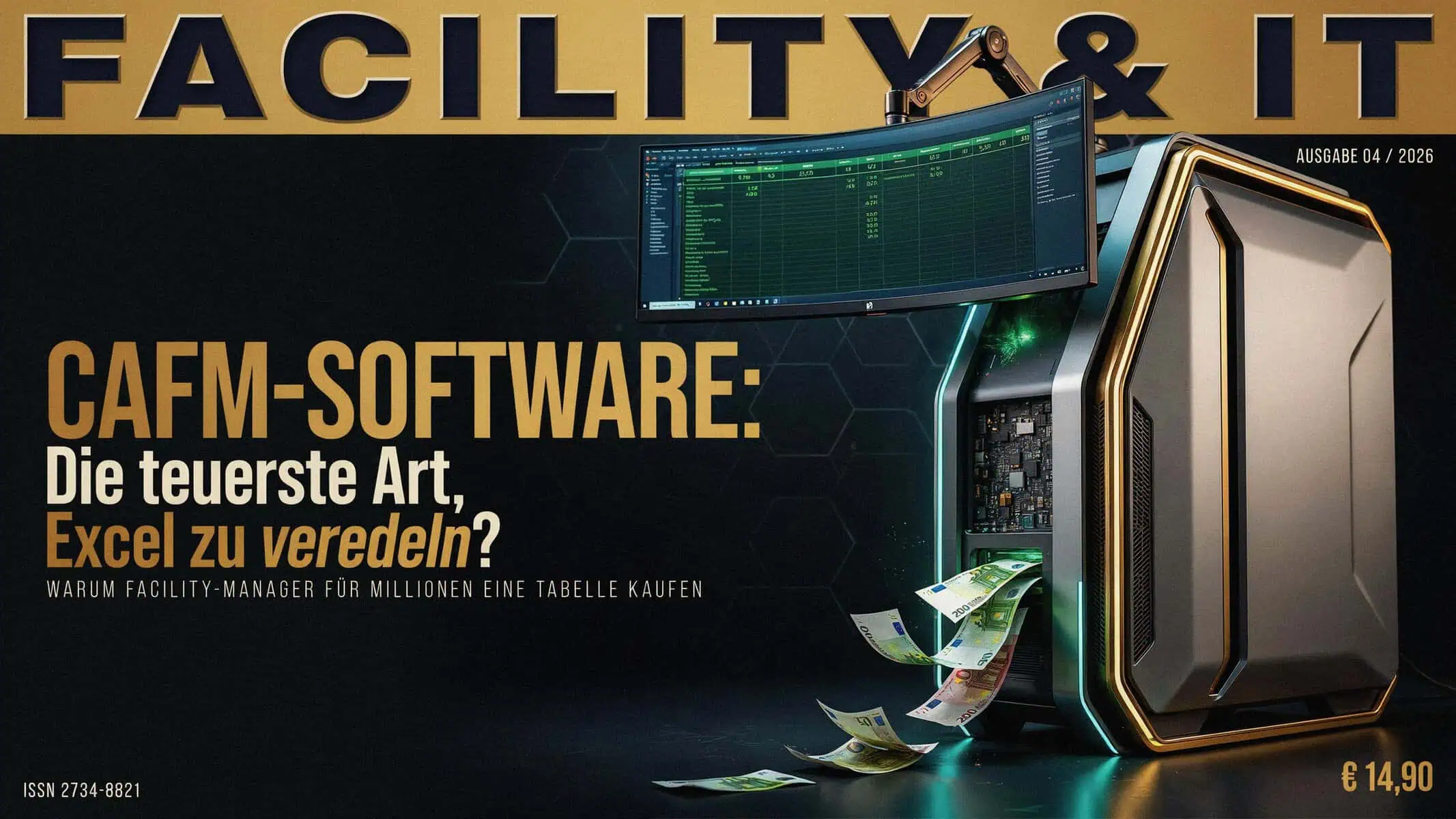
CAFM software should bring order, transparency, and efficiency into Facility Management the organization. In practice, however, it often becomes an expensive system that promises more than it delivers in everyday use.
CAFM software is often sold as the great salvation for facility management: finally transparency, finally clean processes, finally an end to Excel, email, and operational fiascos. That sounds good, but it's also suspiciously smooth. Because whoever looks closer quickly realizes: the idea isn't the problem, but the gap between glossy promises and operational reality.
On paper, CAFM can do almost anything. Manage spaces, control maintenance, track tickets, analyze costs, bundle documents, ensure compliance. All of this sounds like digital reason and a system that finally brings order to established structures. That's precisely why many presentations seem so convincing: They show what could be possible, not what actually happens in everyday life.
And in everyday life, facility management is rarely elegant. Established responsibilities, historical data, half-finished processes, and changing requirements collide there. CAFM is supposed to smooth all of this out, standardize it, and make it visible. But unfortunately, organizational chaos cannot simply be built into software and then hoped to disappear on its own. Because the chaos then just gets faster, not less.
The Cost Trap
The real cost question doesn't start with the license, but with everything that comes afterward. Implementation, data cleansing, interfaces, training, customizations, rollout, support, internal resources: this is the bill that is often conveniently omitted in friendly colors beforehand. In this way, a seemingly sensible project quickly becomes a long-distance financial race.
The way costs are often communicated is particularly noteworthy. The software seems affordable, almost harmless. Only when reality sets in does it become clear what is truly expensive: data maintenance, process definition, and constant rework. Those who underestimate CAFM pay double later – once for the introduction and once for the correction.
CAFM is supposed to create order. In many projects, it first creates effort.
Hardly any word is used as often in the CAFM context as "integration." Ideally, everything should seamlessly (another buzzword...) work together with SAP, CRM, BMS, and all the other systems in the organization. In theory, this is logical. In practice, it's often the point where a project turns into a permanent construction site.
Interfaces are not a side issue, but the actual backbone of the solution. The more systems that need to communicate with each other, the more friction, coordination needs, and maintenance effort arise. Suddenly, it's no longer about facility management, but about data models, permissions, test cycles, and error patterns. This is not bad per se, but it's rarely as charming as it looks in marketing.
Complexity instead of clarity
Many CAFM systems don't have too little functionality, but too much too much of it. The problem then lies not in the lack, but in the overload. Everything can be mapped somewhere, but not always in a way that people actually enjoy using in everyday life. And what is technically available has not yet organizationally arrived.
This leads to a paradoxical situation: the software is officially implemented, but in practice, only a few truly master it. The rest continue to work with detours, interim solutions, and quiet resignation. This is precisely when digitalization becomes a facade. The system is there, but work continues alongside it.
A point often overlooked is user acceptance. Decision-makers love dashboards, reports, and key figures. People in operations primarily love systems that take work off their hands, not ones that impose new steps. If the operation is cumbersome, mobile input is annoying, or simple processes become unnecessarily complicated, resistance quickly builds.
This is not a luxury problem, but a core problem. CAFM software thrives on clean data entry and consistent process utilization. If users bypass it, the project may be formally implemented, but practically failed. Then you don't have digital transformation, but an expensive administration of digital excuses.
What good criticism shows
Critical voices about CAFM are valuable because they clear the fog. They make it clear that such systems are only sensible when goals, processes, data quality, and organization align. Without this foundation, software doesn't become a solution, but an amplifier of existing weaknesses.
This doesn't mean CAFM is superfluous. It just means you shouldn't buy it as a miracle cure. If you want order, you have to clarify processes. If you want transparency, you have to maintain data. If you want efficiency, you have to involve the users. Software can support this, but not replace it.
Conclusion
CAFM software is rarely wrong, but often conceived too broadly and understood too narrowly. It can help enormously if it is implemented cleanly, planned realistically, and operated consistently. However, it can just as easily become an expensive digital monument if treated with overly high expectations, too little discipline, and too much faith in manufacturer presentations.
In the end, a simple rule applies: the organization decides, not the software. Those who see CAFM as a tool can achieve a lot. Those who see it as a shortcut to orderly operations quickly end up with the most expensive form of Excel with a user interface.
