
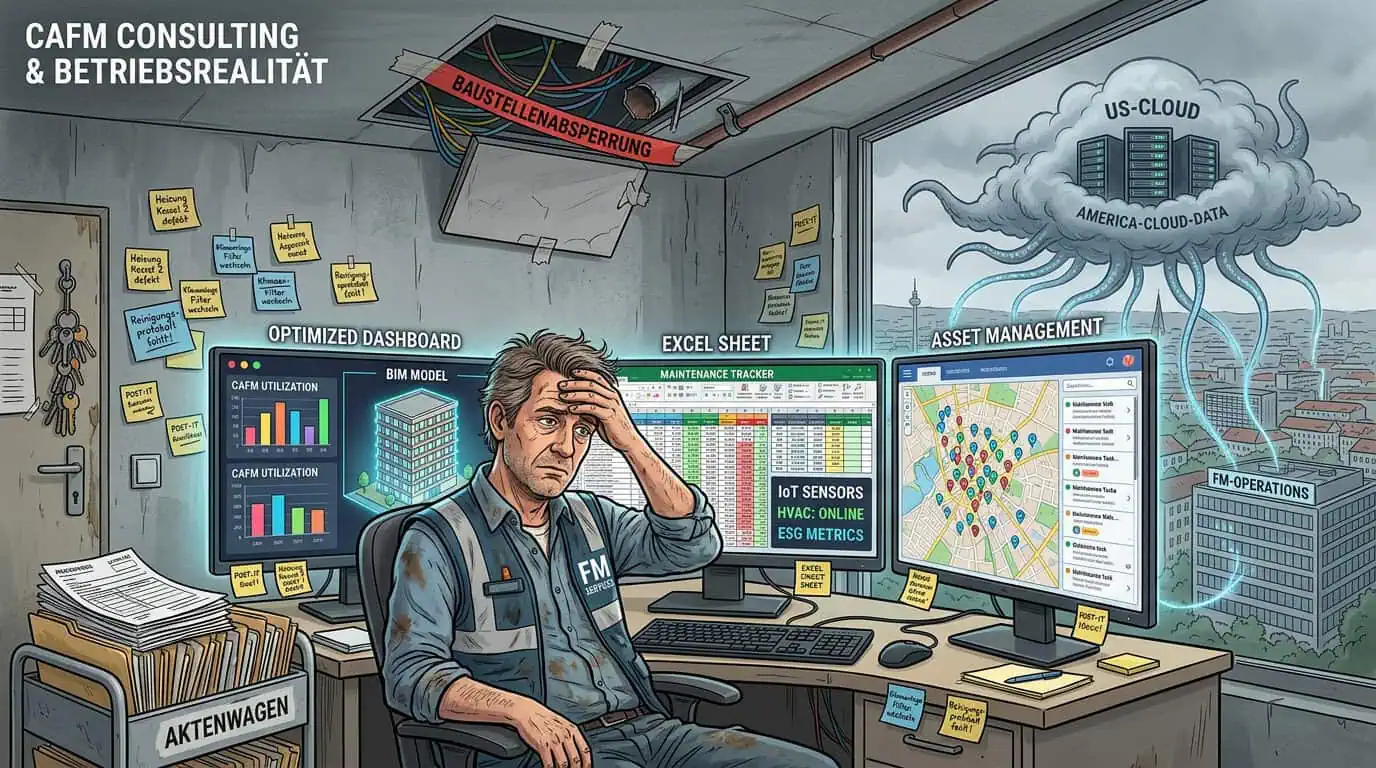
CAFM presentations promise seamless integration, BIM handovers, and IoT solutions (my new favorite word of the month) – the operational reality shows half-maintained master data, Excel islands, and systems that exist but are not really used.
There are two CAFM worlds: the one from presentations – perfect, integrated, digitized down to the last screw – and the one we actually work in. In PowerPoint, everything is "single source of truth" , BIM delivers flawless data, and IoT transforms buildings into smart cabinets of curiosities. In operation, a different drama unfolds: half-maintained master data, Excel islands, mobile apps that no one uses, and processes that are only valid as long as the workshop checklist is still fresh. This discrepancy is not an operational accident.
It's a business model.
Organized Expectation Shift
What is sold as a methodical requirements analysis often ends up as an expectation shift. Workshops produce elegant process maps; the people in operations nod politely; and after go-live, the expensively created target process is ignored in a mix of time pressure and pragmatism. The standard answer is: "More training." The more honest answer would be: "We addressed the wrong problem." Consulting is often measured by how cleanly it formulates requirements – not by whether the solution is used permanently in everyday life.
The US Cloud: Comfort Zone with Loss of Control
Cloud solutions from overseas sound tempting: immediately scalable, always up-to-date, no local server problems. What is often kept quiet: Many of these platforms are built for standardized, centrally controlled processes, not for German operator responsibility with its audit obligations, standards, and regional peculiarities. Customization needs are then replaced with "customizing," prices with "subscription," and sovereignty over data with "terms of service." Result: beautiful dashboards – and worries about data sovereignty, auditability, and long-term costs. And we haven't even talked about the access of American (and other) "services." If the provider changes the terms and conditions, the customer adapts. Not because they want to, but because they have to.
The Fragmented German Market: Diversity as a Problem
Germany has many CAFM providers – and that's exactly the problem. Specialists are good, but the goal of many operators is an integrated platform. The reality: island solutions that are supposed to be linked via interfaces. Interfaces are possible; they are rarely permanently manageable. Every small adjustment in system A causes changes in system B and C. After a few iterations, the landscape loses its consistency, responsibility becomes fragmented, and the "leading system" is eventually just a historical footnote.
BIM: The Salvation That Dies in Operation
BIM promises structured models, rich attributes, handover excellence. In practice, BIM models are created for planning and construction – not for operation. Important operational properties are missing: maintenance intervals, spare part numbers, supplier data, or clear classifications. Anyone who believes that a BIM export package will automatically feed the CAFM often experiences a kind of data death during import: incomplete information, inconsistent attributes, and after a few years, a model that is at best historically interesting. The romantic idea of a one-time data transformation collapses at the latest during the first renovation.
IoT: Data Mountains Without Decision Frequency
Sensors deliver mass, not automatically added value. Occupancy, energy, or climate data pile up in platforms – but without governance, they remain recommendations without consequences. I have seen buildings where clearly measurable space inefficiencies have been documented for months, but political decisions, departmental interests, and archaic space utilization rules prevented any repurposing. IoT without clear responsibilities remains a dashboard that compels no one to act.
Operation is the Litmus Test
A CAFM is not a project with a beginning and an end – it is an operational state. The toughest requirement is data quality. And data quality means maintenance: updating assets, maintaining areas, complete feedback from the maintenance process. As soon as people start using workarounds, trust erodes – and the system becomes a beautiful facade without substance. Fatal: A CAFM that shows perfect reports, even though operations are masking deficiencies, creates a dangerous false sense of security.
CAFM creates transparency. Transparency creates accountability. Accountability creates conflicts.
Dashboards that reveal which areas are poorly maintained or which service providers are performing poorly are not just tools — they are political instruments. If organizations have not learned to deal with open criticism, the data basis is adjusted to make the key figures look better. This is not a conspiracy — it is adaptability to bad incentives.
Typical Anti-Patterns (Brief and Merciless)
- “The tool will improve our processes” — a tool first digitizes what exists; it does not transform bad processes into good ones.
- “We map everything” — over-engineering leads to mandatory fields that users bypass.
- “We will clarify data later” — questionable master data quickly becomes entrenched.
- “The interface will handle it” — integration effort is underestimated; ownership disappears.
- “The users must get used to it” — often the system is impractical, not the people lazy.
Practical Examples — Where Things Went Wrong
Example 1: A medium-sized manufacturing company underestimated the number of mandatory fields in the mobile app; technicians bypassed the system, maintenance reports disappeared into WhatsApp threads, and audits required additional documentation. Result: double the effort, declining trust.
Example 2: A municipal building was subject to strict inspection obligations; the global cloud platform did not provide a suitable inspection module. Workarounds were built in Excel, which could not be consolidated later — the legal situation remained a work in progress.
Example 3: An operator imported BIM data from the new construction; spare part numbers and manufacturer details were missing. Maintenance spent months on post-processing instead of driving operational improvements.
Example 4: An office building installed occupancy sensors; the space policy and departmental interests prevented repurposing. The sensor platform generated nice reports, but the reality remained unchanged.
CAFM in the Context of ESG and Sustainability (Greenwashing vs. Reality)
ESG has become a buzzword — and CAFM is the instrument with which many providers want to make sustainability measurable. It looks good on the slide: CO2 reduction, smart metering, measure tracking. However, the operational reality is different: the degree of digitalization, the data situation, and organizational discipline are often insufficient, so that ESG key figures become more of a PR instrument than a real control variable.
Why this is the case
- Unreliable master data: Without clean area definitions, a correct asset register, and reliable consumption data, CO2 calculations are pure approximations.
- Fragmented data sources: Energy from one platform, maintenance from the CAFM world, occupancy from IoT systems — without governance, the result is a patchwork.
- Reporting focus instead of operational embedding: Some organizations prioritize reporting for investors or ratings over actual process integration.
- Greenwashing risk: Pretty KPIs without a robust basis turn sustainability into a facade.
What CAFM must deliver for credible ESG
- Governance First: Roles, responsibilities, and data ownership are prerequisites.
- Clean base data: Areas, assets, consumption points — complete and well-maintained, please.
- Operational integration: Measures must not only be planned but also tracked and evaluated.
- Realistic roadmap: Step-by-step integration and iterative improvement instead of a "big bang greenwash".
What Works in Practice (Unspectacular, but Effective)
- Radical simplification: A small, cleanly used system beats a bloated suite that no one understands.
- Iterative Introduction: Operate core processes stably, then expand.
- Clear Responsibilities: Appoint data stewards with mandate and resources.
- Operational Discipline: Regular data reviews, audits, and retraining — not as a mandatory event, but as a work process.
- Political Readiness: Decisions on space utilization, vendor changes, and investments are political decisions — they must be made.
Vendor Selection and Sales Tactics (Compact)
- Demos are marketing, not reality — test with real use cases.
- Focus on standard fit, not feature count.
- SLAs, exit strategies, data export: clear regulations on data sovereignty are more important than fancy features.
- Check references: for how long, with what team setup (yes, one of the core problems is: 'Who has how much time for this in everyday life?') and what follow-up projects.
One Last, Hard Truth
CAFM consulting is slowly dying from good intentions and poor implementation. Those who are blinded by the next shiny demo underestimate the operational work that comes afterward. The technology is not the problem — lack of organizational maturity, wrong incentives, and insufficient operational responsibility are. Those who accept this have the best chance of achieving real improvements. And those who continue to collect only buzzwords will soon have nice reports — and inefficient operational practices.
This is not a call to bash technology. It is a call to reality. CAFM can do a lot — but not without people, processes, and hard work. If the industry truly wants progress, it must stop selling digital images and start living digital discipline.
