
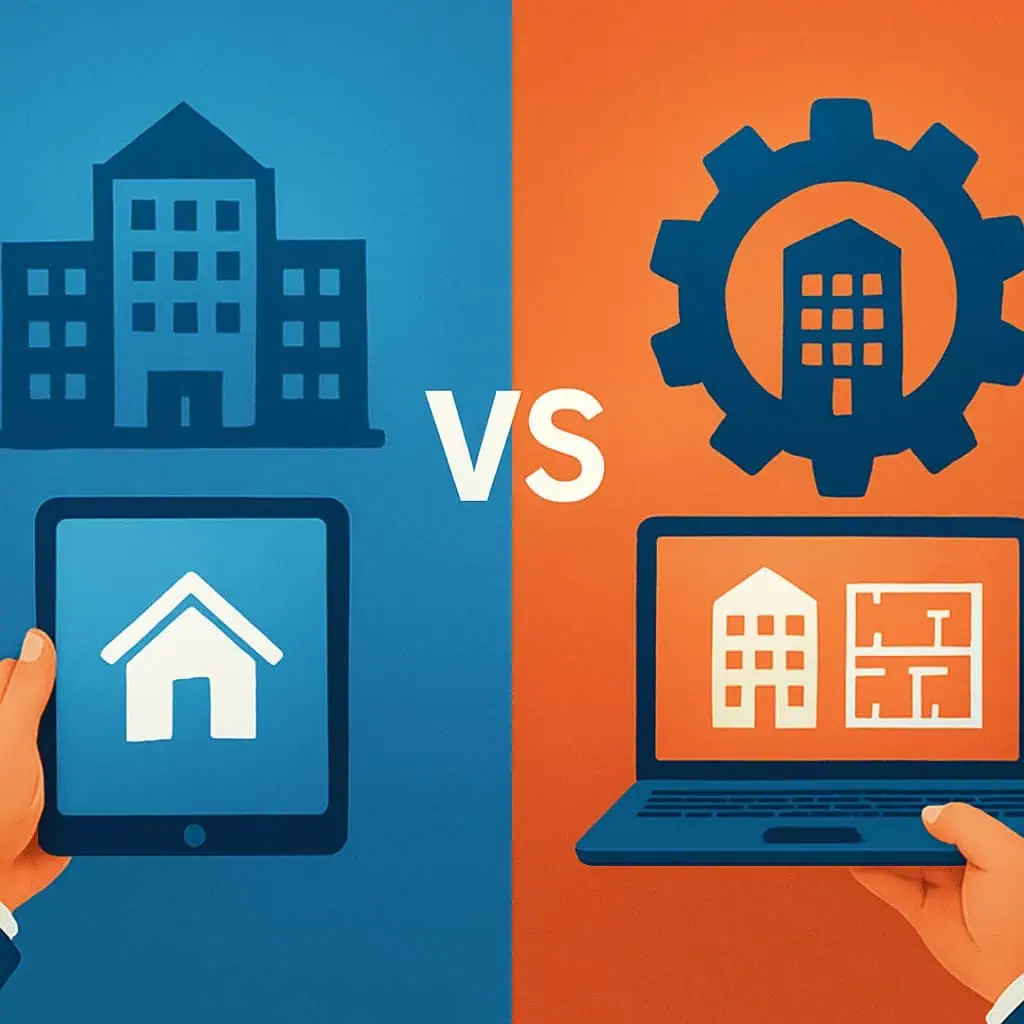
If you manage a mixed real estate portfolio – for example, commercial units paired with residential areas – you will sooner or later face a fundamental question that regularly causes headaches in board and IT meetings: Property Management System (PMS) or Computer-Aided Facility Management (CAFM)?
From numerous consulting projects, I know the typical starting situation: The commercial side swears by the PMS because contracts, tenant communication, and ancillary cost statements need to be handled. The technical side loudly demands a CAFM system because operations will fail without structured asset management, maintenance plans, and space management.
The truth? Both sides are right. And the attempt to force one system to perform the tasks of the other usually ends in an expensive customizing swamp.
Let's soberly examine how to resolve this conflict of objectives, where the real boundaries lie, and why an integrated hybrid architecture is often the most pragmatic approach.
Objectives and Scope: Two Worlds, One Portfolio
Both systems look at the same property, but from completely different perspectives. Before you write a single line of a requirements catalog, you must define measurable target variables: Is the primary focus on reducing vacancy costs and quick ancillary cost statements? Or are operating costs per square meter, asset availability, and warranty tracking the priority?
Core Competencies in Direct Comparison
| Functional Area | Property Management System (PMS) | CAFM Software |
| Commercial Management | Excellent: Lease agreements, indexations, security deposits, ancillary costs | Moderate: Often just pure budget or cost center tracking |
| Operations & Maintenance | Basic: Often rudimentary fault tickets without asset depth | Excellent: Maintenance intervals, CMMS, inspection obligations, warranty |
| Space Management | Contractual: Rentable areas, vacancy lists | Geometric/Operational: Workplace booking, cleaning, occupancy |
| Main target groups | Asset managers, property managers, accounting, tenants | Facility managers, building technicians, service providers, occupational safety |
My conclusion from practical experience: If a PMS provider tries to tell you that its module also maps complete maintenance planning according to VDMA 24186, you should be just as skeptical as with a CAFM provider who claims to handle legally compliant residential ancillary cost statements 'on the side'.
The Hybrid Architecture: No Either/Or Decision
For mixed portfolios, a pure either-or decision is almost always a poor compromise. Those who rely only on a PMS neglect the technical substance of the assets. Those who rely only on a CAFM struggle with commercial processing.
The most modern and sustainable answer is an API-driven hybrid architecture:
-
PMS (Commercial): Manages contracts, tenant portals, and financial flows.
-
CAFM (Technical): Manages the maintenance of pumps, elevators, and HVAC systems, as well as occupancy planning.
-
API Gateway (Integration Layer): Synchronizes data in real-time. If a tenant reports a burst pipe via the PMS portal, a maintenance order is automatically created in the CAFM. The repair status is reflected directly back to the tenant portal.
-
ERP / SAP (Financial & Master Data Authority): Serves as a central anchor for accounting and master data hierarchies.
I accompanied this approach at an owner with around 1,200 residential units and an affiliated commercial park: Through automatic interlocking, response times for disruptions decreased noticeably, and transparency regarding actual maintenance costs per property increased drastically – without employees having to enter data twice.
Technical Architecture & Data Sovereignty: Where the Real Pitfalls Lie
Many digitalization projects fail not because of the user interface, but because of neglected architectural work. "We have open interfaces" is in every sales pitch today. In reality, this often means years of tinkering with unstable REST or SOAP interfaces.
If you want to build a functioning multi-system landscape, you absolutely must pay attention to the following pillars:
-
Uniform Object IDs (Master Data Management): Before starting the system, define how a building, a floor, or a room is uniquely identified. If the PMS calls the object
GEB_01while the CAFM calls itBUILDING_1, chaos is pre-programmed. -
Clearly Regulated Data Ownership: Contractual data belongs in the PMS, technical asset histories in the CAFM, financial master data in the ERP (e.g., SAP S/4HANA). No parallel processing of the same master data in two places!
-
Data Contracts & Versioning: Ensure that interfaces are versioned. A software update of the PMS must not disable data transfer to the CAFM unnoticed.
Total Cost of Ownership (TCO): Think Beyond the License
A common mistake when selecting a system is to focus narrowly on monthly SaaS fees. What good is a cheap license if data migration blows your annual budget?
A realistic TCO (Total Cost of Ownership) calculation must consider at least 5 years calculated over:
| Cost factor | Share of total costs | Practical classification |
| Licenses / SaaS | approx. 30-40% | Easily calculable, but do not underestimate minimum contract terms. |
| Migration & cleanup | approx. 20-25% | The most frequently underestimated item (master data garbage is expensive). |
| Integration & APIs | approx. 15–20 % | Initial connection to ERP/Building Automation & ongoing maintenance. |
| Change Management | approx. 15–20 % | Training and support for employees ensure the usage rate. |
Rule of thumb: The transition of a portfolio with around 1,200 units and 20 commercial properties to a modern cloud-hybrid landscape costs approximately €150,000 in implementation and about €100,000–€120,000 in ongoing annual costs on average. However, after 12–18 months, process automation typically leads to an operational cost reduction of 20 to 25 percent.
Roadmap for Practice: The 4-Stage Model
To prevent your project from ending up in an endless consultant loop, the following phased model has proven effective:
-
Phase 1: Evaluate (Sharpen Requirements)
Create a weighted criteria matrix. Where is the leverage? If 80% of your portfolio consists of highly complex commercial spaces with intensive building technology, CAFM takes priority. For pure residential property management, PMS dominates.
-
Phase 2: Pilot (The Reality Check)
Start with a defined sub-portfolio (e.g., 5–10 properties) and a lean governance team (1 Steering Committee, 1 Data Owner per department). Test the interface between PMS and CAFM in real operation.
-
Phase 3: Rollout (Phased Migration)
Do not adopt data in a 'big bang' approach, but in structured waves. After each wave, data quality and user acceptance are checked.
-
Phase 4: Optimize (Expansion)
Only when the basic elements (contracts, maintenance orders, invoices) are running stably do you connect IoT sensors or predictive maintenance modules.
Summary: Decision Matrix
-
You choose pure PMS if: Your portfolio consists mainly of residential properties or simple commercial spaces, hardly any technical systems are operated in-house, and the focus is purely on rental agreements, deposit management, and ancillary costs.
-
You choose pure CAFM if: You manage complex operating sites, industrial plants, or hospital buildings as an owner-occupier or corporate real estate manager, and commercial lease management plays no role.
-
You choose a hybrid solution (PMS + CAFM via APIs) if: You manage a truly mixed portfolio where both sophisticated lease management and a high degree of operator responsibility and technical system intensity meet.
