
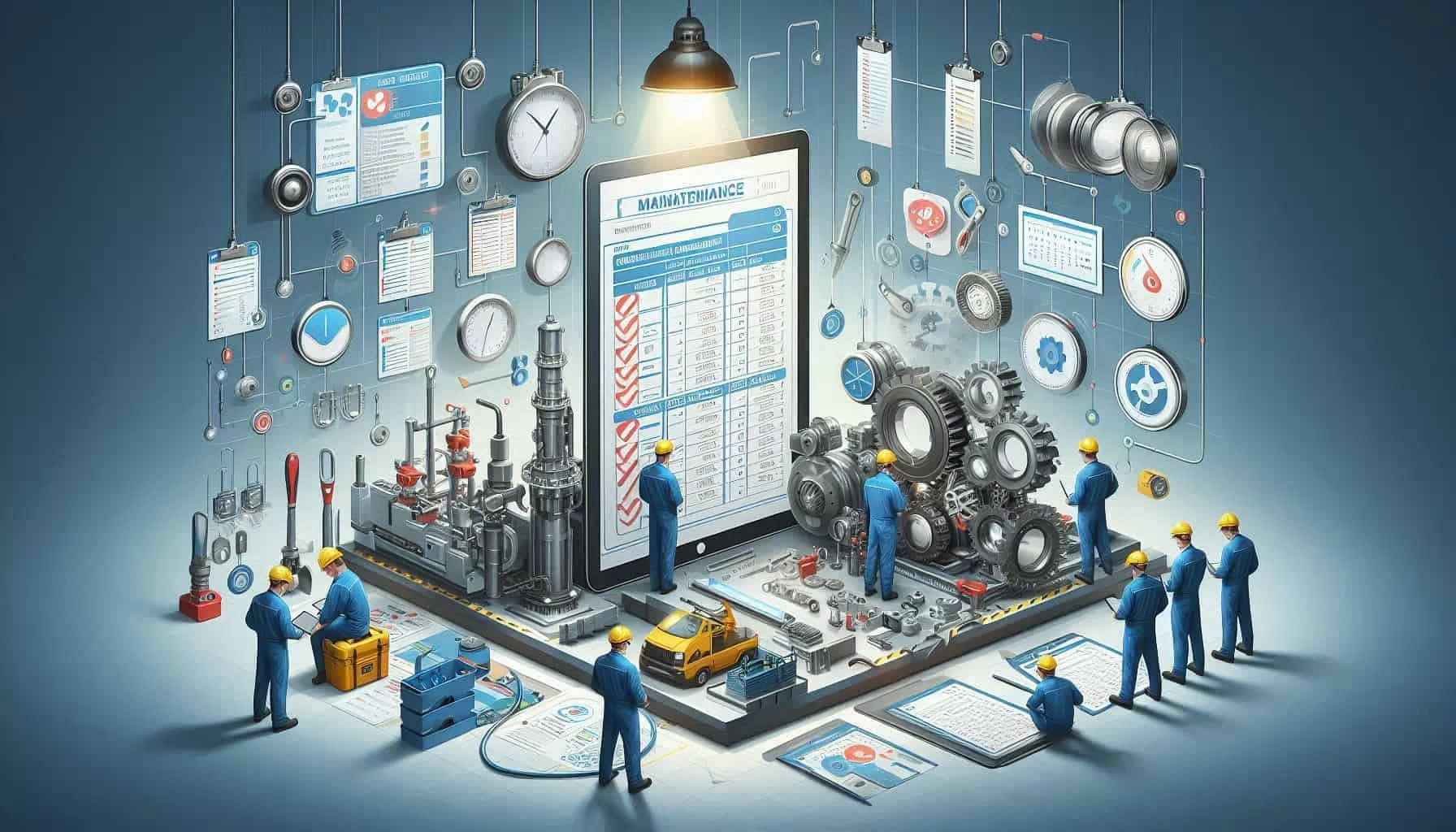
Efficient maintenance management is a central aspect in the operation of technical facilities and infrastructures. It aims to maximize the availability of machines and systems, minimize downtime, and extend the lifespan of assets while optimizing operating costs. This discipline requires a systematic approach that includes planning, execution, monitoring, and continuous optimization.
I. Fundamentals of Maintenance Management
Before discussing specific strategies, it is important to understand the fundamentals on which effective maintenance management is built. A solid foundation significantly contributes to success.
Asset Recording and Classification
To maintain effectively, you need to know what you have. Comprehensive asset recording is the first step. Document every piece of equipment in detail. This includes manufacturer, model, location, age, and usage data. Such an inventory provides the basis for all further decisions.
- Identification of critical assets: Not every asset is equally important. An asset criticality analysis helps identify those components whose failure would have the greatest impact on operations. These assets deserve special attention and higher priority maintenance measures. Imagine your production line is a chain. The critical assets are the weakest links. A break at this point paralyzes the entire chain.
Defining Maintenance Triggers
Maintenance work should not be carried out arbitrarily, but should be based on defined triggers. These triggers can be of various kinds.
- Time-based triggers: These are the simplest triggers, for example, every 90 days. They are easy to plan but do not always take actual usage into account.
- Usage-based triggers: Here, maintenance is triggered after a specific operating time (e.g., 500 operating hours) or a specific number of cycles. This is more accurate than time-based intervals and reflects the actual load.
- Condition-based triggers: These triggers are based on monitoring parameters such as vibrations, temperatures, or pressure. If certain thresholds are exceeded, a maintenance need is signaled. This is the most precise form, as it takes into account the actual condition of the asset.
Developing Maintenance Plans
Once you know your assets and when maintenance is required, you can create detailed maintenance plans. These plans structure the tasks and resources.
- Periodic Plans: Develop daily, weekly, monthly, and annual maintenance plans. Each plan should include clearly defined responsibilities, required spare parts, and tools. A well-structured plan is like a roadmap – it shows where the journey is heading and which stops need to be made.
II. Digitalization and Software Support
Modern maintenance is hardly conceivable without digital tools. Software solutions offer efficient support in managing and carrying out maintenance tasks.
Computerized Maintenance Management Systems (CMMS)
CMMS systems are the backbone of modern maintenance management. They automate a variety of processes.
- Work Order Automation: From creation to completion, work orders are managed digitally. This eliminates manual processes and reduces errors.
- History Tracking: Every maintenance deployment, repair, and replacement is documented and can be retrieved at any time. This history is essential for root cause analysis and future planning.
- Schedule Management: CMMS systems help in planning and monitoring maintenance schedules, ensuring deadlines are met and reminding of upcoming tasks.
Benefits of Maintenance Software
The use of specialized maintenance software offers several advantages over traditional methods.
- Minimizing Administrative Effort: Routine tasks are automated, significantly reducing administrative effort.
- Reducing Time and Costs: Through optimized planning and quick availability of information, maintenance times are shortened and costs are reduced.
- Reliable Documentation: Every action is documented in an audit-proof manner, which is of great importance for audits and traceability.
Future Trends and Technologies (2026)
The field of maintenance is developing rapidly. For the year 2026, various key technologies are already emerging that will revolutionize maintenance management.
- AI-powered systems: Artificial intelligence is increasingly used to recognize patterns in data, predict failures, and optimize maintenance strategies. For example, AI can detect anomalous machine behavior before it becomes a serious problem.
- Connected Worker Solutions: These solutions connect maintenance technicians directly with relevant information and experts, often via mobile devices. This allows access to instructions, diagnostic tools, and real-time support directly at the point of use.
- Augmented Reality (AR) Applications: AR glasses or tablets can project superimposed information (e.g., circuit diagrams, 3D models) directly onto the physical object for technicians. This significantly simplifies complex repairs and the onboarding of new employees.
III. Maintenance Strategies
Choosing the right maintenance strategy is crucial for efficient operation. There is no single “right” strategy, but rather a combination tailored to specific requirements.
Manufacturer Guidelines (OEM)
The first point of reference for maintenance intervals and service tasks should always be the recommendations of the Original Equipment Manufacturer (OEM). These are based on extensive tests and experience of the manufacturer.
- Maintenance Fundamentals: OEM guidelines provide a solid basis for fundamental maintenance intervals and necessary service work. They are like a vehicle's manual – the first point of contact for basic care.
Cost Optimization of Maintenance Intervals
Longer maintenance intervals can reduce the costs of preventive maintenance, but increase the risk and cost of emergency repairs. A balance must be found.
- Balancing Risks and Costs: Optimize maintenance intervals to minimize overall costs. Waiting too long can lead to disasters, while maintenance that is too frequent consumes unnecessary resources. Imagine watering a plant: too much water drowns it, too little lets it dry out. It's about the right amount.
Predictive Maintenance (PdM)
Predictive maintenance is an advanced strategy based on the analysis of real-time data to predict failures before they occur.
- Real-time Data and Trend Analysis: Sensors continuously collect data on the condition of the equipment (e.g., vibrations, temperature, power consumption). This data is analyzed to identify trends and detect potential problems early.
- Predicting Failures: By recognizing patterns and anomalies, PdM systems can predict when a component is likely to fail. This allows for proactive planning of maintenance work, precisely when it is needed, rather than according to a rigid schedule or only after a failure.
IV. Team Coordination and Organization
Unfortunately, in the hustle and bustle of everyday life, the crucial importance of the team is sometimes neglected. Without effective team coordination, even the best technology is ineffective.
Clear Responsibilities and Tasks
Every team member must know their role and tasks precisely. Unclear responsibilities lead to duplication of work or, worse, tasks not being done at all.
- Structured Communication: Establish clear communication channels within maintenance teams and with other departments. Like gears in a clockwork mechanism, all parts must be synchronized to keep the system running.
Regular reviews and adjustments
Maintenance plans are not static documents; they must be regularly reviewed and adjusted. The reality of operations is constantly changing.
- Continuous Improvement: Conduct regular meetings to assess the effectiveness of maintenance plans and make adjustments as needed. Feedback from the team is essential here. This iterative process is like navigating a ship – you need to regularly check and adjust the course to reach your destination safely.
V. Avoiding Common Mistakes and Optimization
There are specific pitfalls in maintenance management that should be avoided. Overcoming these challenges can significantly increase efficiency.
Replacing spreadsheets
Many companies still use Excel for maintenance planning. While Excel is useful for simple tasks, it cannot replace a dedicated maintenance management system.
- Limitations of Excel: Excel quickly reaches its limits when it comes to complex schedules, resource management, historical tracking, and the integration of real-time data. It's like trying to hammer a nail with a screwdriver – it's not the right tool for the job.
Data quality and system integration
The quality of data entered into maintenance systems is crucial for the accuracy of analyses and forecasts. Bad data is like a blurry image – you cannot draw precise conclusions.
- Standardized Data Collection: Implement processes that ensure consistent and accurate data collection.
- Integration with Other Systems: Link your CMMS with other enterprise systems such as ERP (Enterprise Resource Planning), MES (Manufacturing Execution Systems), or SCADA (Supervisory Control and Data Acquisition) to ensure a comprehensive overview and data harmonization.
Training and skills development
The best systems and strategies are useless without competent personnel. Invest in the further training of your maintenance teams.
- Technological Competence: Regularly train your employees on new technologies and systems, especially regarding AI, AR, and PdM.
- Troubleshooting and Problem Solving: Foster the analytical and problem-solving skills of your technicians. A well-trained team is the asset of your maintenance management.
VI. Future Perspectives
Maintenance management is continuously evolving, driven by technological innovations and the desire for greater efficiency and sustainability.
Predictive maintenance as standard
Predictive Maintenance (PdM) is expected to cease being just an option and become the dominant standard for maintaining critical assets. The ability to accurately predict failures and act proactively will be crucial for competitive advantage.
Sustainability and resource efficiency
Maintenance is increasingly viewed from a sustainability perspective. This means not only extending the lifespan of assets but also minimizing resource consumption and waste in the maintenance process.
Cyber security in maintenance
With the increasing interconnectedness of assets and systems, cybersecurity in maintenance management is becoming ever more important. Protection against cyberattacks on IoT devices and control systems is becoming a priority.
Effective maintenance management is a continuous process that requires attention, investment, and adaptability. The principles and trends outlined here provide a guide to optimize your maintenance strategies and make your asset operations future-proof.
