
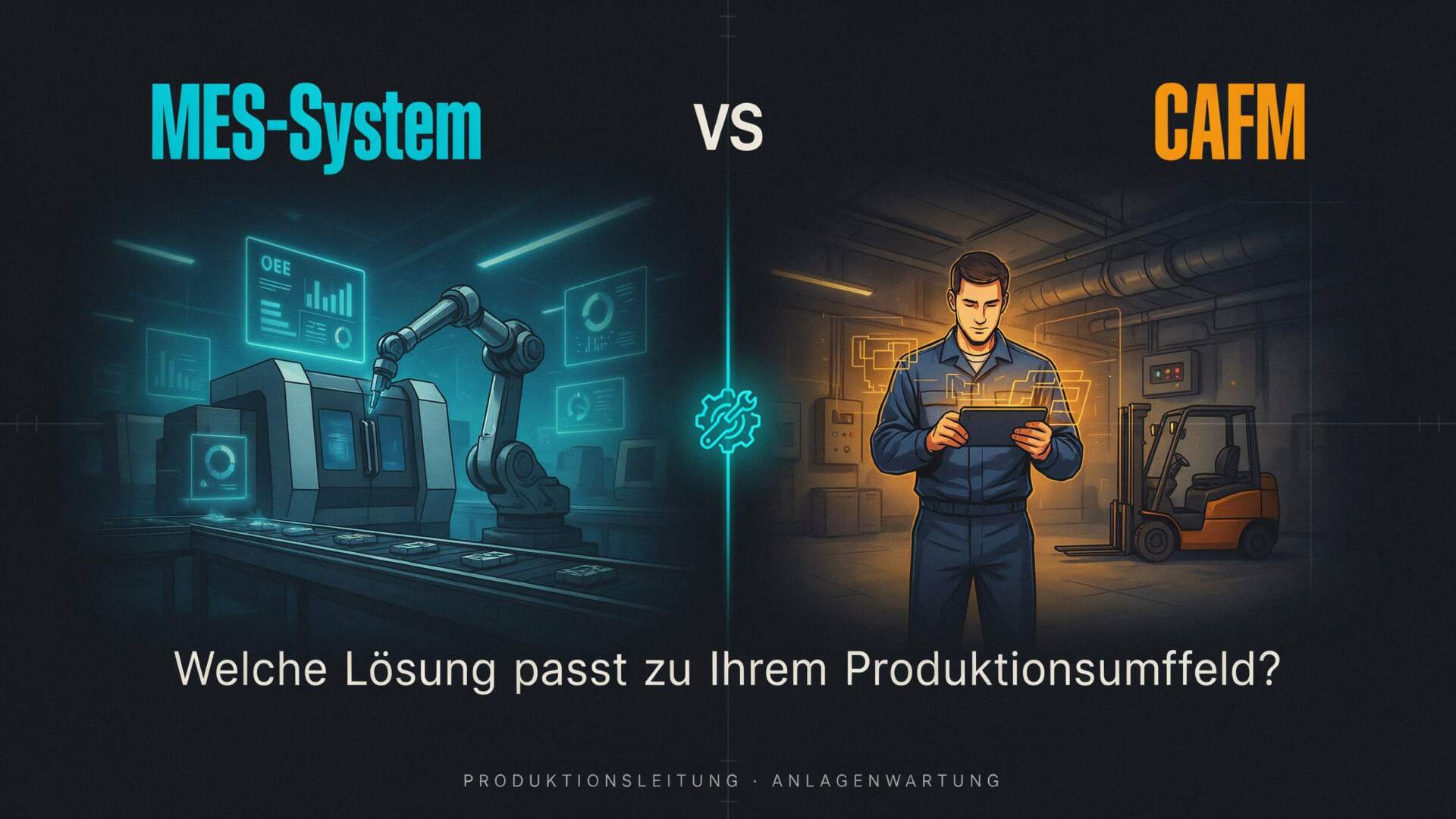
Welcome to the promising land of Industry 4.0 and Smart Facility Management – where marketing departments promise that your factory will practically run itself thanks to AI, IoT, and the cloud, while in reality, the PLC of the main plant is still hanging via an RS232 cable on a Windows XP computer Windows XP computer.
As a consultant who regularly mediates between production-denying COOs, software-enthusiastic CTOs, and infrastructure-focused FMs, I can assure you: The MES (Manufacturing Execution System) vs. CAFM (Computer-Aided Facility Management) debate is the classic among misunderstandings. Anyone comparing apples and oranges here will end up buying two expensive systems that coexist splendidly – without solving a single problem.
Here is the unvarnished architecture guide for C-level and IT decision-makers in manufacturing companies.
1. MES in the Production Environment: Where Heartbeat and Cycle Time Reign
An MES is not a system for managing rooms, but the digital pacemaker of production. It operates precisely in the gap between the strategic ERP level and the physical machines on the shop floor.
| Automation Pyramid | System / Component | Primary Function |
| Strategic Level | ERP System (e.g., SAP) | Rough planning, strategic order planning & resource management |
| Control Level | MES | Detailed planning, real-time control, OEE, BDE/MDE, tracing |
| Field Level | Shop Floor | Physical execution by machines, robots, PLCs, and sensors |
The core functions:
-
Real-time OEE (Overall Equipment Effectiveness): Anyone who wants to know why a plant is running at only 68% efficiency needs MES real-time data – not evening paper submissions.
-
BDE / MDE (Production & Machine Data Acquisition): Automatic capture of fault messages, cycle times, and quantities produced.
-
Batch traceability: Which component was installed with which parameters into which assembly? (Life insurance for suppliers).
The consultant's reality: The benefit of an MES stands or falls not with the software's feature set, but with the quality of the machine connection. If your plant data has to be manually entered into the MES, you have merely purchased a very expensive digital stopwatch.
Takeaway: MES implementations rarely fail due to licensing, but rather due to a lack of interface standards (OPC UA / MQTT) and inconsistent master data.
2. CAFM in Operations: When the Hall is More Important Than the Product
While the MES follows the heartbeat of the product, the CAFM takes care of the body around it – the building envelope, the technical building equipment (TGA), and the space-related resources.
| System | Primary focus | Key Figures & Metrics |
| MES | The Product: Workpieces, processes, and production lines | Quantity, cycle time, scrap rate, OEE |
| CAFM | The Shell: Building, M&E, and space-related resources | Square meters, HVAC condition, maintenance intervals, energy consumption |
The operational area:
-
Space & Occupancy Management: Who uses which hall, where are which assets located (Asset Tracking)?
-
Infrastructural Maintenance: Maintenance of refrigeration systems, compressed air stations, fire protection, and DGUV regulations.
-
Energy Management: Building-related energy consumption (ESG reporting).
The clear distinction: The CAFM knows when the air conditioning in Hall 3 needs maintenance. However, it doesn't know that Hall 3 is currently running an urgent order and that switching off the ventilation would ruin semiconductor production. This is the classic collision zone.
3. MES vs. CAFM: The Decision Matrix for Executives
A direct system comparison quickly makes it clear why a simple 'either/or' question misses the mark:
| Decision dimension | MES (Manufacturing Execution System) | CAFM (Computer-Aided Facility Management) |
| Primary focus | Workpiece, manufacturing process, OEE, cycle time | Buildings, rooms, M&E, infrastructure |
| Time horizon | Milliseconds to shifts (real-time) | Days, months, years (lifecycle) |
| Data sources | SPS, Sensors, OPC UA, Worker Terminals | CAD plans, rent, inspection reports |
| Main user | Shift supervisor, worker, quality management | Facility managers, safety officers, service providers |
| Target KPIs | OEE, MTTR/MTBF (Production), Scrap Rate | Cost per m², Energy consumption/m², SLA fulfillment |
4. Architectures & Integration: How ERP, MES, and CAFM Interact
Anyone who still tries today to map MES and CAFM into a single 'all-in-one' software will fail. The future belongs to a hybrid architecture based on a central middleware / integration platform (iPaaS).
| Architecture layer | System / Component | Task & Integration Flow |
| Leading System | ERP System (SAP) | Manages master data and finances. Sets framework conditions. |
| Mediation layer | Event Bus / Middleware | Synchronizes data via OPC UA / REST between the specialized systems. |
| Real-time control | MES System | Receives orders from ERP, controls Production facilities (PLCs, Presses). Reports events to the bus. |
| Infrastructure Management | CAFM system | Receives events via bus, controls Utility systems (HVAC, Transformers). Reports status back to ERP/Event Bus. |
The API-first approach in practice:
-
The MES controls production and detects, for example, that the temperature at press 4 is rising critically.
-
The event bus sends an event to the CAFM.
-
The CAFM checks if the cooling water supply for the hall is having a problem and automatically generates a maintenance order for the building technology – without the production manager having to pick up the phone.
Important trade-off: Decoupling via microservices or REST APIs increases initial architectural complexity. However, it prevents an upgrade of the CAFM system from paralyzing your production line.
5. TCO and ROI: Where the Costs Are Hidden
A fatal error in C-level calculation is focusing solely on software licenses. A realistic TCO model over 3 to 5 years reveals completely different circumstances:
| Cost block | Share of TCO | Relevance & Risk |
| Software license | 20 – 30% | Visible tip of the iceberg; usually well calculable. |
| Interfaces & Connectivity | 35 – 45% | The iceberg below the surface: Enormous effort for legacy systems. |
| Data Cleansing & Migration | 15 – 20% | Often underestimated; dirty master data ruins processes. |
| Change Management & Training | 10 – 15% | Crucial for employee acceptance on the shop floor/in operations. |
Where the real ROI comes from:
-
With MES: Not through "nicer reports", but through OEE increase (even 3-5% bring millions), scrap reduction, and decreasing lead times.
-
With CAFM: By saving idle times, optimizing facility management service provider contracts, and avoiding fines for faulty operator obligations (compliance).
Cost Trap Cloud vs. On-Premise: Cloud SaaS reduces initial investment (CapEx) but generates ongoing operating costs (OpEx). In the MES environment, a pure cloud solution often fails due to latency on the shop floor – edge or hybrid architecture dominates here.
6. The System Selection Guide: Reaching a Decision in 5 Phases
So that the selection process does not end in an endless consultant loop, a pragmatic phased plan is recommended:
| Phase | Focus of the phase | Description |
| 1. Process Scoping | Demarcation (MES vs. CAFM) | Define what belongs to the MES (touches the component) and what falls to CAFM (affects the room/supply). |
| 2. Architecture Doctrine | API-first / Hybrid Approach | Fundamental decision: No software without a documented REST API or OPC UA interface. |
| 3. TCO Scenarios | 3-5 Years Budgeting | Calculate at least 30% of the budget for master data cleansing and interface development. |
| 4. RFP & PoC | Live Tests Instead of High Gloss | Test the connection of a real machine or a real floor plan in the Proof of Concept live. |
| 5. Piloting | Start in one line/plant | Gather experience with data quality in a protected environment before rolling out the system globally. |
7. Conclusion for the Executive Floor
MES and CAFM are not competitors, but specialists for two fundamentally different worlds in your company. Anyone who tries to expand an MES into a building manager or misuse a CAFM for production control will pay three times in the end. The winning strategy is: Two specialized core systems, united via a clean, central data model.
