
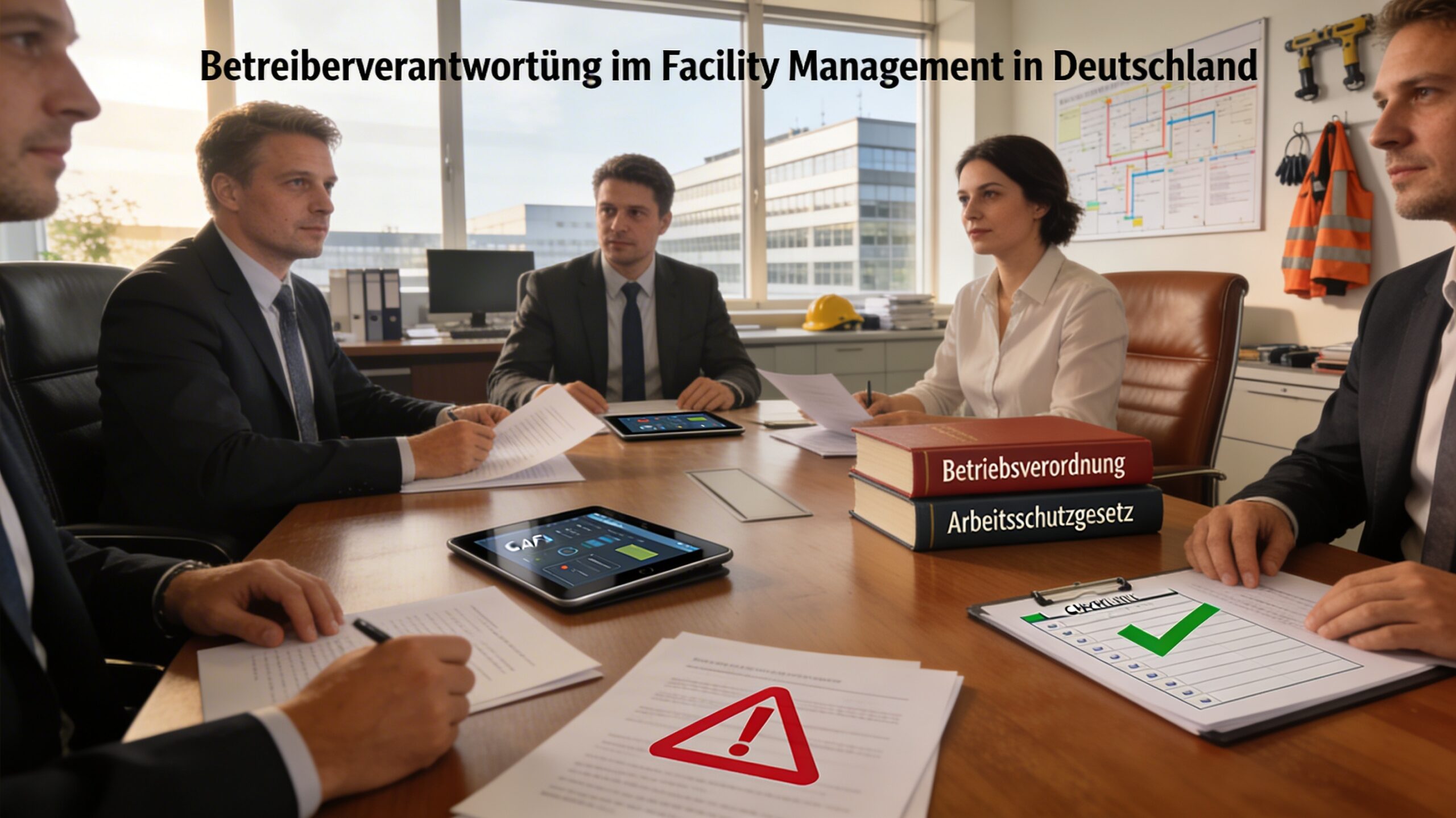
Operator responsibility is a central topic in facility management, derived from a variety of legal requirements. Especially in Germany, the Operator duties are clearly regulated, which presents both an opportunity and a challenge for companies. The legal foundations define not only duties but also liability risks that operators must know and manage.
Legal framework in Germany
Numerous laws and ordinances regulate operator responsibility. These include, among others, the German Occupational Safety and Health Act (ArbSchG), the Ordinance on Industrial Safety and Health (BetrSichV) and the Product Safety Act (ProdSG). These regulations require operators to be responsible for the safety of their facilities and the protection of employees.
A typical practical example is the operation of an office building. Here, the operator must ensure that all technical systems are regularly maintained and that safety regulations are complied with. This includes not only fire protection measures but also compliance with accessibility regulations.
Responsibilities according to BetrSichV and other regulations
The Ordinance on Industrial Safety and Health sets specific requirements for risk assessment and the regular inspection of work equipment. Operators must ensure that all devices and systems are in a safe condition and are regularly checked for their functionality.
Non-compliance with these regulations can lead to significant legal consequences.
A common misconception is that many companies believe they can absolve themselves of responsibility simply by documenting their measures. In reality, it is not enough to just keep records; rather, these measures must be actively implemented and regularly reviewed.
Liability risks and legal consequences of non-compliance
Failure to comply with legal requirements carries significant liability risks. These can range from fines to claims for damages. A specific scenario could be an accident at work where insufficient safety precautions were taken. In such a case, the operator can be held liable.
- - High fines for violations of safety regulations.
- - Personal liability of responsible persons within the company.
Roles and responsibilities in facility management
Operator responsibility in facility management is not monolithic; it encompasses various roles and duties that must be clearly distinguished. Operators are generally responsible for the safety and proper operation of properties. Service providers, on the other hand, perform specific tasks, while users occupy the premises. This distinction is crucial for clearly assigning responsibilities and minimizing liability risks.
Distinction between operator, service provider, and user
The operator bears the primary responsibility for all legal requirements and safety standards. Service providers such as cleaning companies or technical maintenance services have specific tasks that are contractually regulated. Users, on the other hand, are responsible for the responsible use of the resources provided. A common misconception is that operators believe they can shift their responsibility to service providers. This is a fallacy; the legal responsibility remains with the operator.
Contractual aspects of operator responsibility
Contracts between operators and service providers must contain clear regulations on the assumption of responsibilities. For example, it should be specified which safety measures the service provider takes and how often these are checked. A practical example shows that many operators do not adequately address liability issues in their contracts. An insufficiently worded contract can lead to significant financial disadvantages in the event of damage.
- - Clear definition of responsibilities in the contract.
- - Regular review of service providers' compliance with standards.
The operator's responsibility cannot be delegated.
Required qualifications and training for responsible persons
Operator duties in facility management require specific qualifications. Responsible persons should have expertise in areas such as occupational safety and fire protection. In practice, this often means that regular training is necessary to meet current legal requirements. However, many companies underestimate the effort involved in this training or assume that one-time training is sufficient.
A common problem is the overvaluation of certifications as a unique selling proposition. Many teams mistakenly believe that the mere existence of a certificate protects them from liability risks. In reality, these trainings must be actively implemented and regularly updated to be effective.
Implementation of effective risk management
Effective risk management is essential for operators in facility management. It provides a structured approach to identifying and minimizing risks resulting from operator responsibility. This is particularly crucial for companies operating in complex or safety-relevant environments.
Identification of risks in the operation of buildings and facilities
The first phase of risk management involves systematically identifying potential risks. This includes not only technical defects but also organizational weaknesses or insufficient training. A common problem is the assumption that all risks are already known or that they only need to be checked sporadically. In practice, however, the opposite is often true: many operators overlook critical points, which can lead to significant liability risks.
Strategies for minimizing liability risks
To minimize liability risks, operators should develop clear strategies. This includes, for example, regularly conducting risk analyses and implementing preventive measures such as training and maintenance programs. A practical example could be a facility manager who orders monthly safety inspections and maintains a log to document all measures taken.
- Conduct regular risk analyses
- Implement preventive maintenance measures
- Offer training for employees
The operator's responsibility remains even when tasks are delegated.
Documentation and record-keeping as part of risk management
Comprehensive documentation is crucial for providing evidence to supervisory authorities. Operators should ensure that all measures taken are documented. Many companies mistakenly believe that a simple list of maintenance work is sufficient. In reality, this requires detailed logs and regular reports on the condition of the systems.
Typically, teams misunderstand the scope of the required documentation. They often think that digital tools alone can reduce their responsibility. In reality, these tools must be actively used and integrated into a comprehensive process.
Technological support through CAFM systems
CAFM systems are indispensable tools for effectively managing operator responsibility. They offer a structured platform for monitoring and documenting all relevant operator obligations in facility management. This is particularly important for companies operating in highly regulated sectors that must comply with strict compliance requirements.
Integration of CAFM software for monitoring operator responsibilities
The integration of CAFM software can be particularly advantageous for large companies or those with multiple locations. These systems allow all relevant information to be bundled centrally and to react to changes in real-time. An example would be a property manager who uses CAFM software to ensure that all maintenance work is documented and carried out on time. This ensures compliance with legal requirements.
Automation of maintenance and inspection processes through digital tools
The automation of maintenance and inspection processes is one of the greatest strengths of CAFM systems. These tools provide reminders for due maintenance and inspections, which reduces the likelihood of human error. However, this can also lead to some operators relying too heavily on technology and becoming less proactive in checking their systems.
Data analysis for improving operational efficiency and compliance
Another advantage of CAFM systems is the possibility of data analysis. By evaluating operational data, operators can identify and improve inefficient processes. Nevertheless, many teams overestimate the value of this data; without clear objectives or strategies for implementing the insights gained, the potential often remains untapped.
Key Takeaway: Implementing a CAFM system requires active use and regular training for staff.
Inspection and documentation obligations in facility management
Inspection and documentation obligations in facility management are crucial for fulfilling operator responsibility. Operators must ensure that all systems are regularly checked for their safety and functionality. This applies not only to technical systems but also to organizational processes necessary to ensure safe operation.
Regular inspections, maintenance, and their legal requirements
Regular inspections are legally required and form the basis for operator responsibility. Operators are obligated to carry out maintenance work at specified intervals to minimize liability risks. These requirements vary depending on the type of system and the relevant regulations.
A practical example could be a commercial building where monthly safety inspections for electrical systems must be performed. These inspections should be documented to prove, in the event of an audit or official inspection, that all necessary measures have been taken.
However, the actual implementation of these inspection obligations is often insufficient. Many operators mistakenly believe that one-time inspections are sufficient. In reality, it is crucial to establish a continuous process of review and documentation.
Creation of inspection reports and their importance for operator responsibility
Inspection reports are a central element for fulfilling operator responsibility. They document the condition of systems and maintenance work performed, serving as legal proof to supervisory authorities. A well-structured inspection report should contain detailed information about work carried out, any defects, and recommended measures.
Important note: Missing or incomplete inspection reports can lead to significant legal consequences.
- - Detailed list of all maintenance work performed.
- - Clear documentation of defects with recommendations for action.
Dealing with documentation deficiencies and their legal consequences
Documentation deficiencies can not only jeopardize operations but also have far-reaching legal consequences. A common misconception is that many operators believe they can protect themselves solely through digital documentation. In reality, this documentation must be actively maintained and regularly updated.
If deficiencies in documentation are identified - whether through internal audits or external controls - this can lead to substantial fines and even criminal prosecution. A specific example could be an incident where a security gap arose due to inadequate maintenance documentation.
Case studies: Best practices in implementing operator responsibility
The successful implementation of operator responsibility requires practical approaches that have proven effective in various industries. Companies that take this responsibility seriously often demonstrate how clear structure and effective communication can lead to better results.
Successful examples from various industries
An example from industry is a manufacturing company that has implemented a comprehensive safety plan. Through regular training and safety inspections, the company not only ensured compliance with legal requirements but also significantly reduced the accident rate. Such proactive measures show that operator obligations must be taken seriously.
In the healthcare sector, a hospital has significantly improved its compliance by introducing a digital documentation system for maintenance work and inspections. This allowed the hospital not only to meet legal requirements but also to optimize its operating costs.
Analysis of errors from failed implementations of operator responsibility
On the other hand, there are also numerous cases of failed implementations. A common problem is insufficient training for staff. A facility manager of a large office building mistakenly believed that one-time training would suffice. The result was a series of safety incidents attributed to a lack of knowledge.
Key takeaway: Regular training is crucial for maintaining safety and compliance.
Lessons from practical examples for future strategies
A clear strategy for implementing operator responsibility is essential. Many companies underestimate the value of preventive measures such as regular risk analyses and maintenance logs. A facility manager should not rely solely on digital tools; rather, it is important to actively integrate them into daily operations.
- - Conduct regular risk analyses.
- – Active use of documentation tools for tracking maintenance work.
- – Ensure continuous further training of personnel.
Future developments in operator responsibility
Operator responsibility is strongly influenced by various future developments. New technologies and changing legal frameworks, in particular, present operators with new challenges and opportunities.
Influence of new technologies on responsibilities in facility management
Digitalization is a central factor changing operator responsibility. Through the use of IoT (Internet of Things) devices, operators can obtain real-time data on the condition and usage of facilities. This enables proactive maintenance and can help to identify safety risks early on. However, this technology also brings challenges, such as the need to manage data securely and comply with data protection requirements.
Trends in legislation and their impact on the industry
Legislators are increasingly striving to create clear guidelines for operator responsibility. Regulations on sustainability and environmental protection are gaining importance; this requires operators to not only ensure the safety of their facilities but also to implement environmentally friendly practices. These legal changes can have significant impacts on operating costs and require an adaptation of existing processes.
- Increased requirements for the documentation of safety and environmental standards.
- Need to implement sustainable practices in facility management.
Preparation for future challenges in operator responsibility
Best suited are companies that are willing to actively engage with these changes. The integration of new technologies may initially be costly, but in the long run, it is often seen as an investment in efficiency and safety. An example would be the facility manager of a large company implementing a modern CAFM system to digitally manage all maintenance and safety protocols.
Teams often overestimate the effectiveness of technology as the sole solution for compliance issues.
A common mistake is that many teams believe they can overcome all challenges by purchasing a new system. In reality, it requires comprehensive staff training and an adaptation of internal processes.
